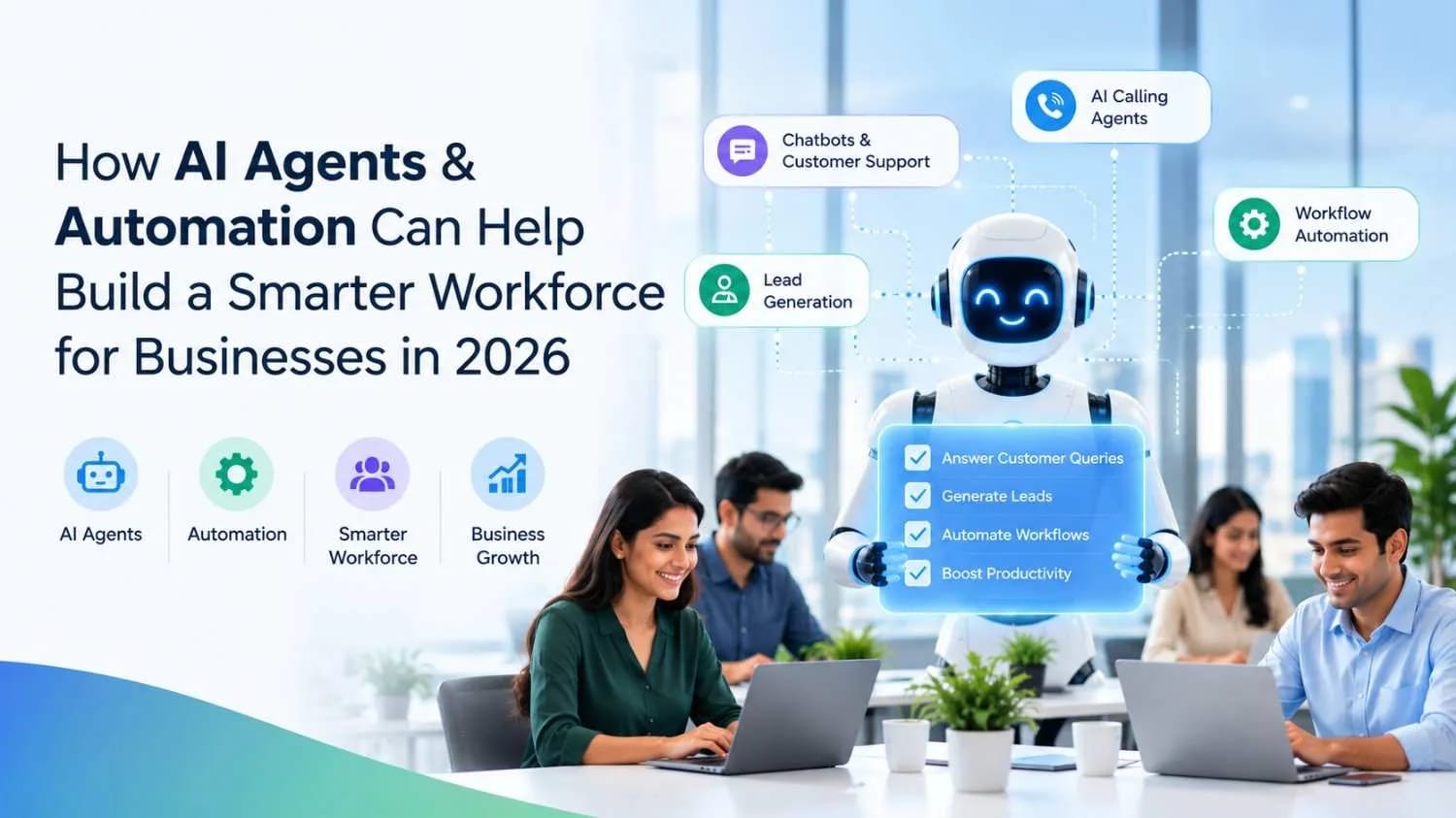
How AI Agents & Automation Can Help Build a Smarter Workforce for Businesses in 2026
Businesses in 2026 want to make their operations run more smoothly, and with the help of artificial intelligence (AI), they can. AI technologies enable organizations to automate processes, communicate with clients, and accomplish other tasks more efficiently.
An AI workforce can be applied to a variety of business needs, from customer service to sales. In this article, you will learn how AI agents, automation, and AI workforce technologies can benefit your business.
1. What Is an AI Workforce for Businesses?
An AI workforce consists of technologies that can be applied to a business context. Some of them are narrow AI systems capable of performing a limited set of actions. For example, an AI calling agent can assist in answering customer questions, while an AI lead generator can gather and organize information about prospects.
More advanced AI systems can understand the input data and operate within established parameters to perform a combination of actions. In general, however, AI technologies are tools that can be applied to a business in order to increase its efficiency.
2. How Can AI Agents Help Automate Businesses’ Daily Tasks?
AI agents for business are programs that perform various actions and complete tasks. Depending on the solution, they can interact with other programs, receive and process input data, and carry out other functions.
These technologies can be applied in multiple areas of operations:
To help with customer care by replying to frequently asked questions and referring more complex requests to actual humans.
In sales, to organize and store information about leads.
As a calling agent, to assist in making and recording appointments.
To extract, store, and summarize data contained in various documents.
To establish and facilitate an automated workflow that covers multiple related tasks.
An example of the last technology is an automated lead nurturing workflow, which can collect and save information about a prospect with minimal input from real humans, thus saving time and effort.
3. What Are the Benefits of AI Automation Services for Organizations?
AI automation services aim to make businesses more efficient by reducing the amount of repetitive, mundane work that has to be done. In addition, these technologies can connect various points in a business process, thus streamlining operations and reducing delays.
Here are some of the advantages of using automation in a business:
Increased Productivity
If AI takes over some of the most time-consuming, repetitive tasks, employees will have more time to plan, develop, and innovate.
Quicker Response to Customers
Depending on the technology, AI chatbots and calling agents can work around the clock or at least outside normal working hours.
Depending on the technology, AI chatbots and calling agents can work around the clock or at least outside normal working hours. This allows organizations to respond to customer inquiries faster, which brings them closer to their goals and increases customer satisfaction.
Fewer Human Errors
When implementing an automated workflow, it is important to ensure that data is correctly transferred from one node to another.
When implementing an automated workflow, it is important to ensure that data is correctly transferred from one node to another. That said, the use of automation reduces the possibility of arithmetic errors or other mistakes that could occur when processing data in Excel.
Scalability
As the business grows, so does the need to complete more work. With AI automation technologies, the workload can be distributed more evenly, and the amount of work that falls to humans can be minimized.
The actual benefits of using AI automation services will depend on the tools used, the quality of their implementation, and the needs of the business.
4. AI Workforce: How Does It Differ from Traditional Workers?
A traditional workforce is comprised of employees who use their skills to perform daily tasks. An AI workforce is different in that it uses technology to assist people. These two approaches are not mutually exclusive, but in most cases, the best results are achieved when humans and AI work together.
For example, an AI lead generator can collect and summarize information about a prospect, but a real estate agent is still needed to actually make the deal. Similarly, technologies such as chatbots or calling agents can assist employees in closing deals and maintaining customer relations.
5. How Can an AI Workforce Benefit Sales and Lead Generation?
Generating leads and qualifying them is a time-consuming sales process, but it is necessary in order to make a deal. This is where AI can be useful. There are several technologies that can benefit sales teams.
For example, AI lead generation tools can collect information about prospects, and sales automation tools can store and organize it. They can also help establish an automated sales workflow, during which qualifying questions addressed to a prospect can be processed by a chatbot or calling agent, and the collected information can be passed on to a CRM.
In addition, such tools can help set reminders to contact clients, update the CRM about new leads, and much more. In fact, any data that seems useful but is too time-consuming to process can be handled by AI agents.
Naturally, the information collected by an AI agent about prospects must be verified by a human, and the use of any personal data must be in accordance with the law. In any case, AI technologies can significantly speed up the process of collecting and organizing information for sales teams, which is one of the main advantages of using an AI workforce.
6. How to Select the Best AI Workforce Tools for Your Business Needs?
When selecting the most suitable AI workforce technologies, it is important to start with a needs analysis. Rather than trying to find ways to use AI in every business process, determine which operations are more time-consuming and can benefit from being automated.
Once you understand how an AI agent can optimize your business, you will be able to select the most appropriate technologies. The first step is to identify the most time-consuming processes in the current operations.
Next, it is necessary to establish specific, measurable goals — what changes do you want to see after introducing automation?
Once the goals have been established, the next step is to choose the tools that will help you achieve them.
It is important to choose technologies that work well with the existing CRM and other business software. A pilot project is a good way to test new technologies. Once a certain automation has been established and improved, it is important to keep track of expenses and measure the results.
In any case, implementing AI automation technologies must be accompanied by a strategy that takes into account the strengths and weaknesses of the team, as well as the capabilities of the technologies used. A human-centered approach also means having approval processes for decisions that require human judgment.
7. Why Choose AIWorksForce for Business Automation and AI Agents?
AIWorksForce helps businesses streamline their operations and increase their overall efficiency by providing the best AI workforce solutions. If your company is considering using AI to improve your operations and you are looking for an experienced partner, we can help you.
Whether you are interested in AI-powered sales tools, chatbots, or calling agents, the key to success is to understand your needs and the ways in which your operations can be optimized. With the help of AIWorksForce, you can increase the productivity of your business and get more value out of your time and resources.
You can learn more about our AI-based workforce solutions by visiting the page AI Workforce Solutions. If you are interested in discovering how you can use AI automation technologies, you can visit the AI Automation Services page, and if it is available, the AI Agents for Business page.